


Frequently Asked Questions
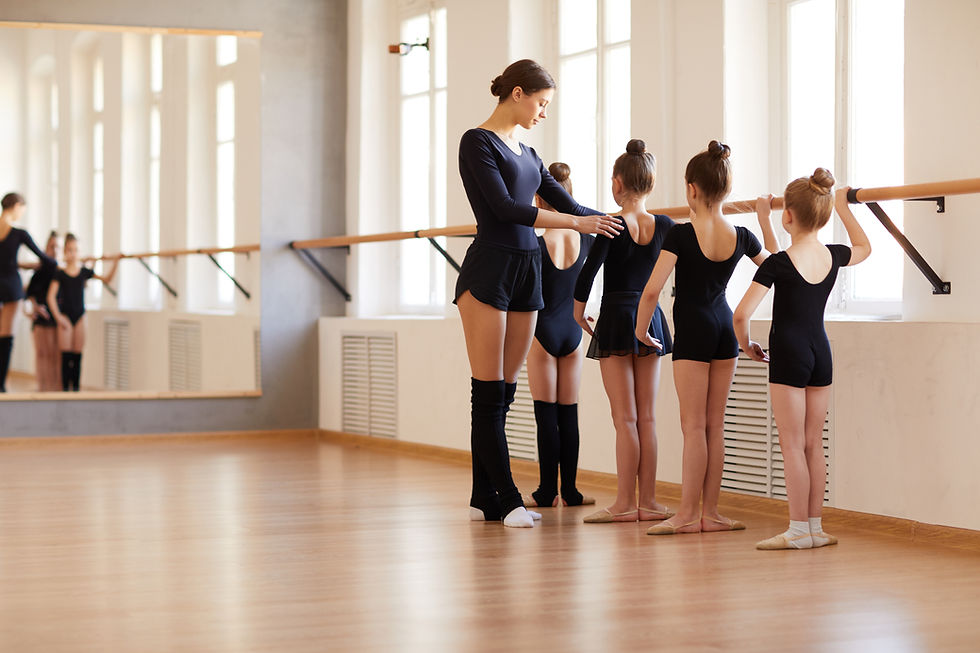
Ballet is one of the most popular hobbies for young children. For many, dance accompanies them throughout their lives, and a few even go on to perform pirouettes on the world’s biggest stages one day. Here, we summarize the most important facts about ballet as a hobby for children.
What do you do in ballet? Structure of a ballet class
At the beginning, dancers warm up at the barre. A fixed sequence of exercises is performed there, designed to strengthen individual muscle groups and build the foundation for ballet positions and movements in the open space.
Barre training is usually introduced only after one to two years of ballet lessons and at the earliest from around six years of age. Younger children are introduced to these exercises in a playful way, for example by comparing movements to animals. Students first train facing the wall with both hands on the barre, and later alternate using the left or right hand. This early stage of professional ballet training is called “early dance education” or “creative children’s dance” in many ballet schools. This progression is very important so that children develop the correct posture while learning to dance — and posture is everything in ballet.
After barre work, several exercises follow in the center of the room, which are similar to those at the barre. These mainly train balance, spatial awareness, and jumping ability. The exercises are often combined into dance sequences, forming small choreographies.
The final major section includes large jumps and turns across the diagonal of the room, such as the split jump (“Grand Jeté”). The diagonal is the longest straight line in the room, making it ideal for practicing pirouettes as well.
At the end of the class, dancers rehearse specific dances that will be performed in ballet shows. This allows the young ballerinas to regularly demonstrate what they have learned.
A ballet class in the beginner stage lasts 45 minutes and later increases to 60 or 90 minutes.
What do children need for ballet classes?
➤ Soft ballet shoes made of fabric or leather; later pointe shoes (from around 12 years of age).
➤ Ballet leotard.
➤ pink silk tights.
➤ possibly a ballet skirt and leg warmers.
How much does ballet cost?
from 80 euros per month
Is ballet healthy?
As with any sport, the right balance is important. Bloody toes and an overextended back can be observed in professional dancers, but this is generally not part of ballet as a hobby for children. In principle, movement is very healthy and important for children. Dancing also develops a sense of rhythm, musicality, and memory skills. In addition, ballet training includes exercises for strengthening muscles and improving fitness. With continuous training, posture improves and the child gains better body control, which also contributes to a positive body awareness.
In ballet, the focus is not on winning but on the joy of dance, music, and beautiful movements. The goal is not competition, but the stage, and performing in front of an audience can have a lasting impact throughout life.
What else can children learn in ballet?
Ballet offers children much more than movement and fun. It has been proven that dance training positively influences the mental, psychological, and social development of children and teenagers. By learning and performing movement sequences, new neural connections are formed in the brain. As a result, children who dance regularly often have better spatial awareness, which can also benefit subjects like mathematics.
In ballet, factors such as social background, nationality, or popularity do not matter—any child can dance. Staying committed even when it becomes challenging, and observing one’s own progress, helps build character and perseverance. Performing in front of an audience can also improve a person’s confidence when speaking or presenting in front of others. Learning to handle nervousness and still deliver performance is an important life skill in today’s world.
Teaching method?
Of the four methods—the Cecchetti method (Italy), the English method, the Vaganova method (Russia), and the Balanchine method (USA)—the Russian and English methods are the most common in Germany.
Most professional training institutions teach according to the Vaganova method. So if you are aiming for performance-level training for your child, this method is often considered the foundation. The Vaganova system is designed as an eight-year program, with strong emphasis on precise technique and carefully structured progression, where each exercise builds systematically on the previous one. In recreational ballet, the same structure is generally followed but in a more condensed form.
The English method, also known as RAD (Royal Academy of Dance), is often used in children’s ballet because many movements are developed in a more playful and accessible way. In RAD, the music is fixed for specific exercises, while in Vaganova it can vary.
Sophia Gesierich